Homeowners, neighbours of building sites
Neighbour's building work: a condition survey before it starts.
Building work is starting next door? Before the first digger arrives, record the condition of your property: with your own dated photos, with a report by a public officer, or with an expert appointed by a court before any lawsuit, where your country allows it. The heavier the stakes, the stronger the tool should be.
By Emmanuel Fernandez, CEO of Proov-It · Updated
Cracks, leaks, loose tiles: after a neighbour's building work, the discussion always turns on the same question, “was it already there?”. A pre-construction condition survey answers it in advance by recording the condition of your property before work starts. Depending on the country and the stakes, it can be your own dated photos, a report by a public officer, or an assessment by a court-appointed expert ordered before any lawsuit.
In France, for example, the référé préventif lets a court appoint an expert who describes the neighbouring buildings before the works, in the presence of the parties; a lighter option is a report by a commissaire de justice (formerly a huissier). Your own dated photos replace neither, but they can be taken at once, without an appointment, for the whole property. To compare these tools, see our comparison of timestamps and official reports. For your own building work, it is the handover of the works that you need to document.
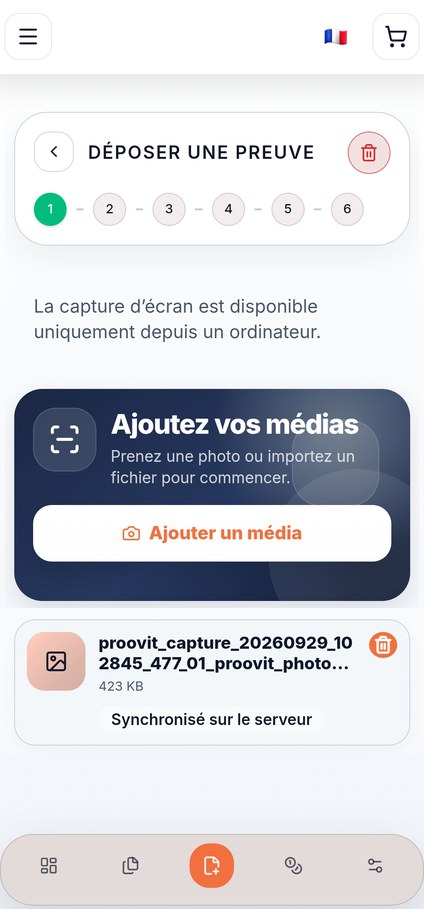
With Proov-It, you photograph and film your property in the mobile app before work starts, then at each stage. Each file is timestamped, geolocated if you allow it, and its fingerprint is anchored on a blockchain. You can send the proof to your neighbour for approval: their response, signature or reasoned refusal, is dated in the certificate.
Photos, official report or court-appointed expert?
| Proov-It timestamped photos | Report by a public officer | Court-appointed expert | |
|---|---|---|---|
| Who records | You, with your smartphone | A public officer, such as a bailiff where the country has one, at your request | An expert appointed by the court |
| Neighbour present | No, unless you send them the proof for approval | Not required in France | In France, yes: the expert calls the parties |
| Cost | €2 at most per submission for an individual | The officer's fees: ask for a quote | In France, an advance on the expert's fees set by the court, plus procedural costs |
| Timing | Immediate | Depends on the professional's availability | The time of a court procedure, then the assessment |
| Typical use | Documenting it yourself, before and during the works | A reference condition described by a public officer | Major works, party walls, high stakes |
Legal framework
No EU rule: the French example.
There is no EU rule on recording the condition of a property before a neighbour's building work. Each country has its own tools: reports by a public officer, expert assessments ordered by a court before any lawsuit, or simply the parties' own evidence. Several countries, France, Germany and Italy among them, allow a court to order an expert assessment before proceedings begin, so that evidence is preserved; the conditions, the cost and the competent court are set by national law.
In France, for example, if there is a legitimate reason to preserve or establish, before any lawsuit, evidence of facts on which the outcome of a dispute may depend, investigative measures may be ordered at the request of any interested party, on application or in summary proceedings (Article 145 of the French Code of Civil Procedure). This is the référé préventif: before the works, the court appoints an expert who describes the condition of the neighbouring buildings. When the measure concerns a property, only the court where it is located has jurisdiction. According to the official French Service-Public guidance on court-ordered expert assessments, the court designates the party who pays an advance on the expert's fees, the expert calls the parties, and the court is not bound by the expert's conclusions.
Still in France, after the works, an owner, tenant, occupier or project owner who causes others a disturbance exceeding the normal inconveniences of neighbourhood is liable as of right for the resulting damage (Article 1253 of the French Civil Code). It still has to be shown that the cracks or other damage appeared with the works: hence the value of a dated reference condition before they start.
Step by step
Before, during and after the works: the method.
The reference condition is recorded before work starts: afterwards, every crack is open to argument.
Spot the works early
Planning permission notice, a letter from the neighbour, an information meeting: as soon as you know, note the planned start date and the name of the contractor.
When announcedPhotograph your property before the works
Façades, party walls, ceilings, tiling, existing cracks with something to show scale, room by room. A video walking round each room complements the close-ups.
Before work startsSuggest a joint inspection
Invite the neighbour or the project owner to record the condition of your property with you, and send them your photos for approval: their response, signature or reasoned refusal, is dated.
Before work startsOfficial report or court expert, depending on the stakes
Structural work, excavation, demolition, a party wall: a report by a public officer, or a court-appointed expert where your country's procedure allows it before any lawsuit. The project owner sometimes takes the initiative: ask.
High stakesKeep records during the works
One submission at each heavy phase or each new crack, with its date: the timeline builds up as you go.
DuringRecord afterwards, and report
When the works end, take the same photos in the same order. Report any damage in writing to the neighbour and the project owner, and inform your insurer.
AfterWhat Proov-It adds
What your photos establish, and what they do not.
What the certificate establishes
- +The condition of your property on the anchoring date, before work starts and at each stage.
- +The integrity of the photos and videos, which the neighbour, the expert or the court can check without a Proov-It account.
- +The geolocation recorded at capture in the mobile app, if you allow it.
- +The neighbour's response, if you send them the proof for approval: signature or reasoned refusal, dated.
What it does not establish
- −The link between the works and any damage: that is the expert's job.
- −A report by a public officer or a court-ordered expert assessment: Proov-It does not replace them.
- −Anything outside the frame of the photos.
- −The liability of the neighbour or the contractor, which the court assesses.
Use cases
Before the works: what you document.
Party wall
Both sides if possible, and existing cracks measured.
Existing cracks
Each crack with something to show scale, to track how it changes.
Ceilings and tiling
The surfaces most sensitive to vibration, room by room.
Excavation and demolition
The surroundings, fences and low walls before the machines arrive.
During the works
Dust, vibration, one-off damage, dated as it happens.
End of the works
The same views, in the same order, for comparison.
How it works
A proof in three steps.
No jargon, no technical skills. You submit or you capture, we certify.
Choose or capture
Documents, photos, videos. Or take a photo or video directly in the app.
Add the context
A comment, tags, a folder. To organise your proofs and find them easily.
Submit
You receive a PDF certificate attesting to the file's existence and integrity on the anchoring date and, for a capture made in the app, the geolocation recorded at that moment.
Does it hold up in court?
A Proov-It certificate can be produced as evidence; the court assesses its weight. We attest to the anchoring date, the integrity of the file and, for a capture made in the app, the recorded geolocation, not the truth of its content.
Frequently asked questions
What we are often asked.
What is a pre-construction condition survey?
A record of the condition of a property before nearby building work starts, so that damage appearing later can be compared with it. Depending on the country, it can be carried out by the parties themselves, by a public officer, or by an expert appointed by a court before any lawsuit. In France, that court procedure is the référé préventif, based on Article 145 of the French Code of Civil Procedure.
Who pays for a court-appointed expert?
That depends on national procedure. In France, the court designates the party who pays an advance on the expert's fees; the judgment that later decides the dispute determines who finally bears the costs. The project owner of the works sometimes applies for a référé préventif against the neighbours.
How much does a report by a public officer cost?
The price depends on the officer and the extent of the findings: ask for a quote before committing. Your timestamped photos cost €2 at most per submission for an individual.
Are my photos enough without an official report?
They can be submitted as evidence, and the court assesses their weight. For heavy works or a party wall, an official report or an adversarial expert assessment remains stronger; your dated photos complement them and cover what happens in between.
What can I do if cracks appear after the works?
Report them in writing to the neighbour and the project owner, inform your insurer and document them. Liability rules depend on the country; in France, whoever causes a disturbance exceeding the normal inconveniences of neighbourhood is liable as of right (Article 1253 of the French Civil Code), provided the link with the works is shown.
Which court should I apply to?
The court designated by the law of the country where the property is located. In France, when the measure concerns a property, only the court where it is located has jurisdiction (Article 145 of the French Code of Civil Procedure), and a lawyer is mandatory above €10,000.
Sources and legal texts cited
- French Code of Civil Procedure, Article 145: investigative measures before any lawsuit (Légifrance, in French)
- Service-Public (French government): court-ordered expert assessment, sheet F35219 (in French)
- French Civil Code, Article 1253: abnormal neighbourhood disturbance (Légifrance, in French)
- Service-Public (French government): distance selling, delivery of goods, sheet F10037 (in French)
Keep reading
Related pages
Handover and snagging photos
At handover, photograph the work, each snag and its clearance with timestamped, geolocated photos that every party can verify. First proof free.
Timestamp comparison
Non-qualified timestamp, qualified timestamp, report by a public officer: evidential weight, cost and use of each tool, to choose for each case.
Insurance claim photos
Water damage, fire, storm: photograph the damage before repairs with timestamped, geolocated photos that the insurer and the loss adjuster can verify.
Timestamped photo evidence
eIDAS Article 41, national rules of evidence, the court's assessment: what gives a photo weight as evidence, and how a timestamp makes it stronger.
Also see: Features · How it works · Pricing · FAQ