Couriers, tradespeople, sellers
Proof of delivery: a dated photo, the place and the recipient's signature.
The customer says they received nothing, or a damaged item? The burden usually falls on whoever delivers. Photograph the handover in the app, dated and geolocated, then send the proof to the recipient: their signature or reasoned refusal is dated in the certificate.
By Emmanuel Fernandez, CEO of Proov-It · Updated
“I never received this parcel.” “It arrived damaged.” Faced with these claims, the burden usually falls on whoever delivers: a business seller bears the risk until the customer takes physical possession, and needs to be able to show the handover. A solid proof of delivery says what was handed over, in what condition, where, when, and whether the recipient accepted it.
The signed delivery note remains the basis. Dated, geolocated photos of the handover complement it, especially when the customer is not at home, the signature is missing or damage is disputed afterwards. To prove a service rather than a delivery (cleaning, repair, assignment), see our page on proof of service.
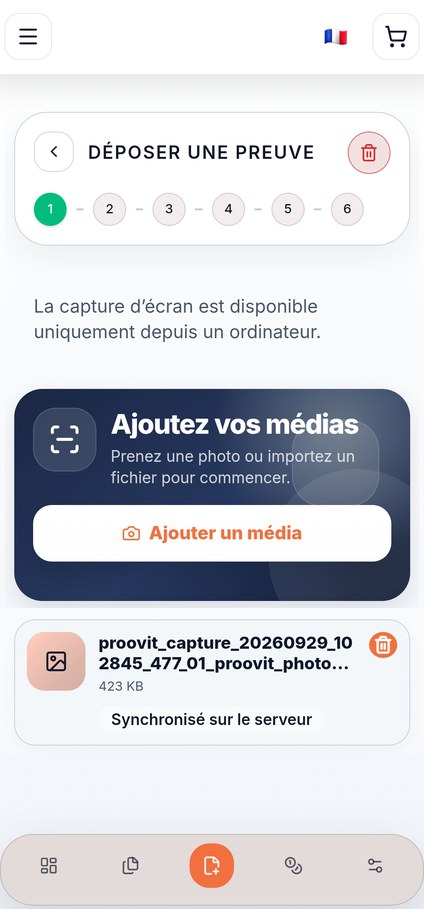
With Proov-It, the courier photographs the handover in the mobile app, attaches the delivery note, then sends the proof to the recipient for signature or approval. Each response, drawn signature or reasoned refusal, is dated and notified, with automatic reminders, and each party receives a copy of the certificate.
Legal framework
Who has to prove delivery?
Under EU consumer law, delivery means transferring physical possession or control of the goods to the consumer (Article 18 of Directive 2011/83/EU), and when the trader dispatches the goods, the risk of loss or damage passes to the consumer only when they, or someone they have designated other than the carrier, acquire physical possession (Article 20). Until then, a lost or damaged parcel is the seller's problem: the seller has every interest in being able to show the handover.
Who must prove what is decided by each country's rules of evidence. In France, for example, the person claiming to be released from an obligation must prove the fact that extinguished it (Article 1353 of the French Civil Code): it is for the seller or service provider to prove delivery. Between traders, commercial acts can be proved by any means (Article L110-3 of the French Commercial Code), and the proof of a fact such as a handover is free too, except where the law provides otherwise (Article 1358 of the French Civil Code). Photos, a signed delivery note and messages can be produced as evidence, and the court assesses their weight.
A recipient who finds damage can note reservations, and the deadline to protest to a carrier is often short: in France, a reasoned protest must reach the carrier within 3 days of receipt (Article L133-3 of the French Commercial Code). A handover that is photographed, dated and approved by the recipient limits later disputes, without making them impossible.
Step by step
From handover to certificate: the method.
The proof is created on site, at the moment of handover: a few more seconds for the courier, a lot of time saved in a dispute.
Photograph the goods before handover
The parcel or item, its label and its condition, just before handing it over: the condition in which you deliver.
On sitePhotograph the handover and the place
The item handed over or left, the door, the letterbox, the street number. Geolocation is recorded at capture in the app, if it is allowed.
HandoverAttach the delivery note
Signed note, order number, any reservations from the customer: in the same submission as the photos, up to 20 files of 100 MB.
HandoverCustomer not at home: document the agreed drop-off
Neighbour, safe place, letterbox: photograph where and how the item is left, as agreed with the customer, with the delivery notice.
Customer absentSend for signature or approval
The recipient receives a link by email and signs, or refuses with a reason. Automatic reminders are sent, and each response is notified to you, dated.
After handoverShare the certificate
Each party receives a copy of the certificate by email; the customer, the client or the insurer can check it without a Proov-It account.
ClosingThe Proov-It app
Take the handover photo in the app.
Capturing in the app records the capture date and, if you allow it, the geolocation; the submission is then timestamped and anchored. Business plans include submissions every month and several users per account: each courier submits from their own phone.
What Proov-It adds
What your proof of delivery establishes, and what it does not.
What the certificate establishes
- +The anchoring date of the submission, which is the date that counts, and the capture date of each photo, shown in the certificate.
- +The geolocation recorded at capture in the mobile app, if it is allowed.
- +The integrity of the photos and of the attached delivery note, which the customer can check without a Proov-It account.
- +The recipient's response: drawn signature or reasoned refusal, each dated.
What it does not establish
- −That the recipient checked the contents of the parcel.
- −The identity of the person who signs: the link goes to the email address you enter.
- −That the customer read the email: only their response shows it.
- −The outcome of a dispute: the customer, the insurer or the court assesses the whole file.
With the recipient's signature
Which date counts?
When you request a signature, the certificate shows several dates:
Capture date
For each photo, the certificate shows its capture date, recorded by the app when the photo was taken. It places the handover in time, but it is not timestamped.
Date of each response
Each signature or reasoned refusal from the recipient is dated in the certificate.
Anchoring date
The RFC 3161 timestamp and the blockchain anchoring take place after the last signature: this is the date that counts. If the exact time of the handover matters, make a submission without signatories on site, then a second submission sent for signature.
Use cases
Proof of delivery: what you document.
Hand delivery
The goods handed over, the place, then the recipient's signature.
Customer not at home
The agreed drop-off (neighbour, safe place), photographed with its surroundings.
Furniture or appliances
The condition of the item once installed, before leaving, and any reservations.
Materials delivered to a site
The materials dropped off, dated, with the signed note.
Sale to an individual
The item handed over in person, and the buyer's approval.
Handing over keys or documents
What is handed over, to whom, and the recipient's dated response.
How it works
A proof in three steps.
No jargon, no technical skills. You submit or you capture, we certify.
Choose or capture
Documents, photos, videos. Or take a photo or video directly in the app.
Add the context
A comment, tags, a folder. To organise your proofs and find them easily.
Submit
You receive a PDF certificate attesting to the file's existence and integrity on the anchoring date and, for a capture made in the app, the geolocation recorded at that moment.
Does it hold up in court?
A Proov-It certificate can be produced as evidence; the court assesses its weight. We attest to the anchoring date, the integrity of the file and, for a capture made in the app, the recorded geolocation, not the truth of its content.
Frequently asked questions
What we are often asked.
Who has to prove a delivery?
Usually whoever delivers. Under EU consumer law, when a trader dispatches goods, the risk passes to the consumer only when they acquire physical possession (Article 20 of Directive 2011/83/EU). The burden of proof itself is set by national law: in France, for example, the person claiming to be released from an obligation must prove the fact that extinguished it (Article 1353 of the French Civil Code).
Is a photo proof of delivery?
It can be produced as evidence. Dated, geolocated and unaltered, taken at the moment of handover and backed by the delivery note or the recipient's response, it is harder to challenge than an ordinary photo; the court assesses its weight.
How do I prove delivery when the customer is not at home?
Photograph the drop-off agreed with the customer (neighbour, safe place, letterbox) with its surroundings, attach the delivery notice, then send the proof to the customer for approval.
Can the recipient sign from their phone?
Yes. They receive a link by email, valid for 14 days, and draw their signature or refuse with a reason. Automatic reminders are sent, and you are notified of each response.
Which date counts when I request a signature?
The anchoring date: the RFC 3161 timestamp and the blockchain anchoring take place after the last signature. The certificate also shows the capture date of each photo, recorded when it was taken, but that date is not timestamped. If the exact time of the handover matters, make a submission without signatories on site.
How much does a proof of delivery cost?
Business plans include submissions every month, from €8.33 excl. VAT per month with yearly billing. An individual pays one token per submission, €2 at most, and the first submission is free.
Sources and legal texts cited
- French Civil Code, Article 1358 (Légifrance)
- French Commercial Code, Article L133-3: protest to the carrier (Légifrance)
- French Civil Code, Article 1353: burden of proof (Légifrance)
- French Commercial Code, Article L110-3: proof between traders (Légifrance)
- Directive 2011/83/EU on consumer rights, consolidated version (EUR-Lex)
Keep reading
Related pages
Service delivery proof and condition reports
Deliveries, move-in, move-out, cleaning, damage: dated and geolocated photos and videos.
Damaged parcel
Parcel damaged on delivery: what to write on the delivery slip, refusing it, complaining to the seller or carrier, and a dated unboxing video.
Lost or missing parcel
Parcel lost, marked delivered but never received, or delivered empty: who is liable, which deadlines apply, and how to complain.
Proof of work completed
Call-outs, maintenance, repairs: before-and-after photos and time of visit, dated and geolocated.
Also see: Features · How it works · Pricing · FAQ