Tenants and landlords
Rental deposit return: deadlines, deductions and what to do.
How long a landlord has to return the deposit, and what can be deducted, depends on the country where the property is located: there is no EU rule. In France, for example, it is 1 month after the keys are returned if the move-out report matches the move-in report, 2 months otherwise, with a penalty for late return.
By Emmanuel Fernandez, CEO of Proov-It · Updated
The question comes up at every move: how long does the landlord have to return the deposit? The rental deposit return deadline is set by national law, not by EU law, so it differs from one country to another. In France, for example, it is one month after the keys are returned if the move-out report matches the move-in report, and two months otherwise, for unfurnished and furnished lets alike.
Depending on the country, a deposit not returned on time can carry a penalty: in France, 10% of the monthly rent for each month or part-month of delay. A deduction, for its part, must be justified. The dispute almost always comes down to comparing move-in and move-out: that is the subject of our guide to the move-out inspection.
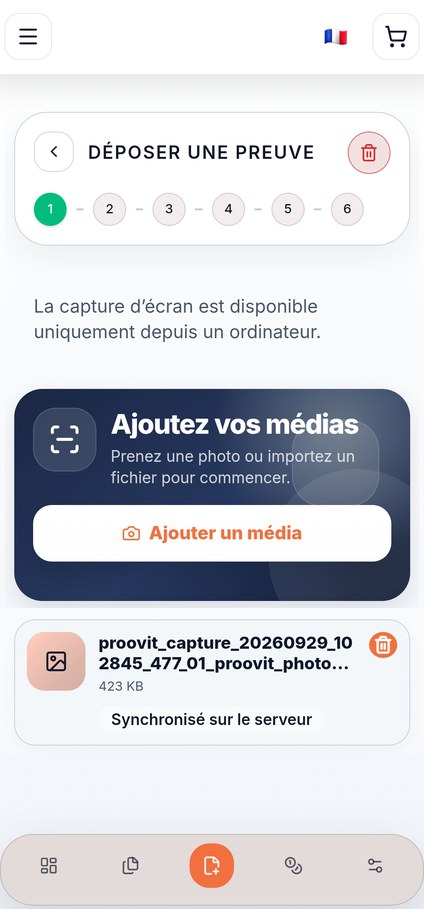
With Proov-It, you photograph each room in the mobile app on move-out day, and put the signed condition report and proof of key return in the same submission. The files are timestamped, geolocated if you allow it, and their fingerprint is anchored on a blockchain. A submission costs €2 at most for an individual, and the first one is free.
Legal framework
No EU rule: the French example.
There is no EU rule on rental deposits: the amount, the return deadline, permitted deductions and any penalty for late return are set by each country's housing law, and by your lease. Check the rules of the country where the property is located.
In France, for example, the deposit must be returned within one month of the keys being returned if the move-out report matches the move-in report, and within two months otherwise, less any sums still owed to the landlord and any duly justified deductions (Article 22 of French Act No. 89-462). If it is returned late, the amount owed is increased by 10% of the monthly rent, excluding charges, for each month or part-month of delay, unless the delay is because the tenant did not give a new address. In a co-owned building, the landlord may keep up to 20% of the deposit until the annual accounts are approved.
Still in France, the tenant is liable for damage during the tenancy, except in cases of force majeure, the landlord's fault or a third party's act, and repairs due to wear and age are not the tenant's responsibility (Article 7 of French Act No. 89-462). Any deduction must therefore be justified: condition reports, photos, quotes or invoices. Other countries set their own deadlines and rules, which may be shorter or longer.
Step by step
Deposit not returned: the method.
The return of the keys is the first date to pin down: in France, for example, the deadline runs from it.
Prepare the move-out with your move-in photos
Go back over the move-in report and your photos, room by room, and deal with routine maintenance before the inspection.
Before moving outPhotograph on the day of the move-out inspection
The same shots as at move-in, in the same order, plus the meter readings. Attach the signed condition report to the same submission.
Move-out dayDate the return of the keys and give your new address
By hand against a signed written note, or by registered post. Give your new address in writing: in France, without it, the late-return penalty does not apply.
Key returnWork out the deadline
The deadline set by the law of the country where the property is located. In France: 1 month after the keys are returned if the move-out report matches the move-in report, 2 months otherwise.
DeadlineAsk for evidence of deductions
Quotes, invoices, photos: a deduction must be justified. Compare each item with your move-in and move-out photos, and with normal wear and tear.
On receiptSend a formal notice
A letter by registered post stating the date the keys were returned, the applicable deadline, the amount owed and, where the law provides one, the late-return penalty.
After the deadlineConciliation, then court
Use the free conciliation or mediation services your country offers, then the competent court. Check the limitation period that applies.
Before time runs outThe Proov-It app
Photograph the move-out with the app.
The same photos as at move-in, taken in the app on the day of the move-out inspection, timestamped and anchored on submission with the signed condition report: everything you need to discuss each deduction on evidence. The first submission is free, no credit card needed.
What Proov-It adds
What your photos establish, and what they do not.
What the certificate establishes
- +The condition of each room on the anchoring date, on the day of the move-out inspection.
- +The integrity of the photos and of the attached condition report, which the landlord, a conciliator or the court can check without a Proov-It account.
- +The geolocation recorded at capture in the mobile app, if you allow it.
- +That the documents submitted (condition report, proof of key return, letters) existed on the same date.
What it does not establish
- −The date the keys were returned: that is proved by a written document or a registered letter.
- −Whether something is normal wear and tear or damage.
- −The amount of a deduction, which the court assesses in a dispute.
- −The joint condition report: it still has to be drawn up and signed with the other party.
Deductions
What a landlord may deduct, or not.
Three common situations, judged case by case, here under French law:
Damage
A hole in a door, a burnt carpet, a broken tile: a deduction is possible if the damage was not noted at move-in, with supporting evidence (quote or invoice).
Normal wear and tear
Paint faded after several years, flooring worn in walkways: in France, repairs due to wear and age are not the tenant's responsibility.
Unpaid rent or charges
Sums still owed may be deducted; in a co-owned building, up to 20% may be kept until the accounts are approved.
Use cases
Deposit return: what you document.
Moving out
Every room, the fittings and the meters, on the day of the inspection.
Returning the keys
The signed handover note or the registered post slip, attached to the submission.
Disputed deduction
The item deducted, compared with the move-in photo and the move-out photo.
Furnished let
The furniture and equipment on the inventory, photographed one by one.
Landlord's side
The condition returned and the repair quotes, to justify a deduction.
Co-owned building
The service charge statement and the amount kept back, with their dates.
How it works
A proof in three steps.
No jargon, no technical skills. You submit or you capture, we certify.
Choose or capture
Documents, photos, videos. Or take a photo or video directly in the app.
Add the context
A comment, tags, a folder. To organise your proofs and find them easily.
Submit
You receive a PDF certificate attesting to the file's existence and integrity on the anchoring date and, for a capture made in the app, the geolocation recorded at that moment.
Does it hold up in court?
A Proov-It certificate can be produced as evidence; the court assesses its weight. We attest to the anchoring date, the integrity of the file and, for a capture made in the app, the recorded geolocation, not the truth of its content.
Frequently asked questions
What we are often asked.
How long does a landlord have to return a deposit?
It depends on the country where the property is located; there is no EU-wide deadline. In France, for example: 1 month after the keys are returned if the move-out report matches the move-in report, 2 months otherwise (Article 22 of French Act No. 89-462 of 6 July 1989).
What can I do if the deposit is not returned?
Send a formal notice by registered post, stating the deadline and any penalty provided by law. Without an answer, use the conciliation or mediation services available in your country before going to court. In France, an attempt at an amicable settlement is in principle required before going to court for a claim of up to €5,000.
Is there a penalty for late return?
That depends on national law. In France, 10% of the monthly rent excluding charges for each month or part-month of delay, added to the deposit still owed; it does not apply if the delay is because you did not give your new address (Article 22 of Act No. 89-462).
Can the landlord deduct money for normal wear and tear?
Not in France: repairs due to wear and age are not the tenant's responsibility (Article 7 of French Act No. 89-462). The landlord may deduct justified sums for damage, or unpaid rent and charges. Check the rules of your country, which may define these notions differently.
Are photos enough to challenge a deduction?
They can be submitted as evidence, alongside the move-in and move-out condition reports, which remain the reference. Dated, geolocated, unaltered photos are harder to challenge; the conciliator or the court assesses their weight.
Can I skip the last month's rent to recover my deposit?
In France, no: according to Service-Public, the tenant cannot deduct the deposit from the last rent payment. Elsewhere, check the rules that apply before doing anything of the kind.
Keep reading
Related pages
Move-out inspection
Moving out of a rental: how to prepare the inspection, what to photograph room by room, and how to compare it with the move-in report.
Insurance claim photos
Water damage, fire, storm: photograph the damage before repairs with timestamped, geolocated photos that the insurer and the loss adjuster can verify.
Timestamped photo evidence
eIDAS Article 41, national rules of evidence, the court's assessment: what gives a photo weight as evidence, and how a timestamp makes it stronger.
Online proof for individuals
Neighbours, rentals, purchases, creations: prove the prior existence and integrity of any content.
Also see: Features · How it works · Pricing · FAQ