Purchases from a business
Legal guarantee of conformity: at least 2 years, and the evidence to keep.
A product bought from a business breaks down or turns out to be defective? Under EU rules, the seller is liable for at least 2 years from delivery and must repair or replace it. If the defect appears within the first year (two years in some countries), it is presumed to have existed at delivery: you do not have to prove where it comes from.
By Emmanuel Fernandez, CEO of Proov-It · Updated
The legal guarantee of conformity protects consumers who buy goods from a business, in a shop or online, new or second-hand. Under Directive (EU) 2019/771, the seller is liable for at least 2 years from delivery for any lack of conformity, and must bring the goods into conformity. It applies by law, with no extended warranty to buy. Each country transposes the directive into its own law, sometimes with longer periods.
Its main strength is the presumption: a defect that appears within one year of delivery, or two years where the country has chosen that period, is presumed to have existed at delivery. You do not have to show where the fault comes from; it is for the seller to prove otherwise. You still need to show when the defect appeared and what it looks like. For a purchase from another private individual, it is the national rules on hidden defects that apply.
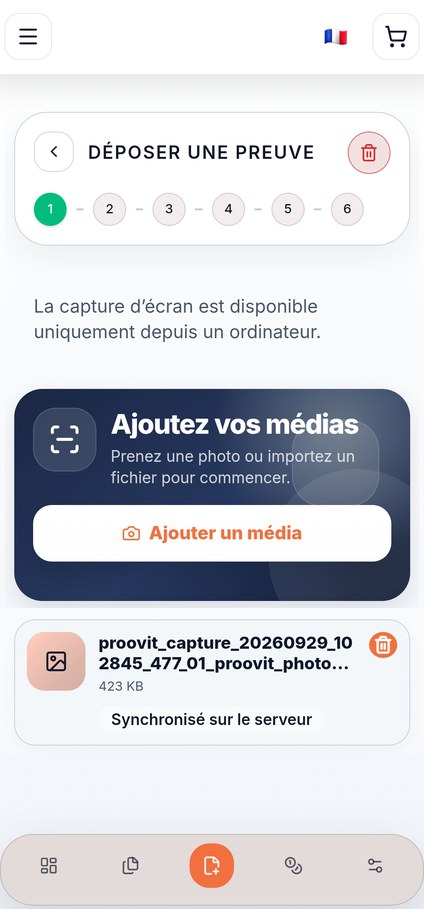
With Proov-It, you film the defect in the mobile app and put the video, the photos and the invoice in one submission. Each file is timestamped, geolocated if you allow it, and its fingerprint is anchored on a blockchain. The same habit is useful when you hand the product over to after-sales.
Legal framework
What the EU directive provides.
Directive (EU) 2019/771 on the sale of goods applies to contracts concluded since 1 January 2022 between a consumer and a business seller, in a shop as online. The seller is liable for any lack of conformity which exists when the goods are delivered and becomes apparent within two years of delivery (Article 10). This is a minimum: countries may keep or introduce longer periods, and for second-hand goods they may allow the seller and the consumer to agree on a shorter period, which cannot be less than one year. The guarantee is owed by the seller, and is separate from any commercial guarantee or extended warranty.
A lack of conformity which becomes apparent within one year of delivery is presumed to have existed at delivery, unless proved otherwise (Article 11). Countries may extend this period to two years. During the presumption period, it is for the seller to show that the defect did not exist at delivery; afterwards, it is usually for you to show that it did. Countries may also require you to inform the seller within at least two months of discovering the defect (Article 12).
You choose between repair and replacement, unless the option chosen is impossible or disproportionately costly for the seller (Article 13). Repair or replacement must be free of charge, within a reasonable time and without significant inconvenience (Article 14). If the seller refuses or fails, or if the defect persists or is serious, you are entitled to a proportionate price reduction, or to terminate the contract unless the defect is minor. Under Directive (EU) 2024/1799, which Member States must apply from 31 July 2026, the liability period is extended once by 12 months when the goods are repaired; check how your country has applied it (at the time of writing, the French Consumer Code still provides a 6-month extension, Article L217-13). In France, for example, the guarantee lasts 2 years and the presumption 24 months for new goods, 12 months for second-hand goods (Articles L217-3 and L217-7 of the French Consumer Code).
Step by step
Fault or defect: the method.
Act early within the guarantee period, ideally during the presumption period: that is when the burden of proof weighs least on you.
Find the delivery date
Invoice, delivery note, order confirmation: the delivery date starts the guarantee period and the presumption period, whose length depends on your country.
As soon as it failsFilm the defect in context
A video of the appliance that will not switch on, the abnormal noise, the faulty screen, with the serial number visible: an intermittent fault shows better on video than in a photo.
As soon as it failsWrite to the seller, not the manufacturer
Ask in writing for repair or replacement under the legal guarantee of conformity, and attach the invoice and the certificate for your photos and videos. Some countries set a deadline for informing the seller: do it without delay.
Within the periodPhotograph the product handed to after-sales
Before handing it over, photograph it from every angle, accessories included: if breakage or cosmetic damage is held against you on its return, you will know what condition it left in.
At handoverWatch the time taken
Repair or replacement must be done within a reasonable time, which some countries cap: in France, 30 days from your request. If it is not done, or the seller refuses, ask for a price reduction or termination of the contract.
Reasonable timeFollow up, then get help
No answer: formal notice in writing, then the consumer mediator indicated by the seller or your national consumer authority; for a purchase from a seller in another EU country, a European Consumer Centre can help.
After a refusalThe Proov-It app
Film the fault with the app.
A fault that comes and goes is easier to prove on video: in the app, photos and videos of up to 10 minutes are timestamped and anchored on submission, with the invoice in the same proof. The first submission is free, no credit card needed. On a computer, you can also submit your files online.
What Proov-It adds
What your photos and videos establish, and what they do not.
What the certificate establishes
- +The anchoring date of your photos and videos of the defect, to compare with the delivery date.
- +The integrity of the files, which the seller or the mediator can check without a Proov-It account.
- +The condition of the product when you hand it to after-sales.
- +The geolocation recorded at capture in the mobile app, if you allow it.
What it does not establish
- −The origin of the defect: lack of conformity, wear or misuse is a technical question.
- −Your request to the seller: you still have to make it in writing.
- −The delivery date, which appears on the invoice or delivery note.
- −The outcome: the seller, the mediator or the court assesses the whole file.
Use cases
Legal guarantee: what you document.
Broken household appliance
The appliance malfunctioning, filmed with its rating plate.
Smartphone or computer
The screen, the battery, the fault at start-up, with the serial number visible.
Refurbished or second-hand product
The defect found, with the business's invoice and the delivery date.
Furniture or bedding
Sagging, a crack, an assembly defect, with something to show scale.
Handover to after-sales
The full condition of the product and its accessories when you hand it over.
Back from repair
The product returned, and the defect that persists, filmed as soon as it comes back.
How it works
A proof in three steps.
No jargon, no technical skills. You submit or you capture, we certify.
Choose or capture
Documents, photos, videos. Or take a photo or video directly in the app.
Add the context
A comment, tags, a folder. To organise your proofs and find them easily.
Submit
You receive a PDF certificate attesting to the file's existence and integrity on the anchoring date and, for a capture made in the app, the geolocation recorded at that moment.
Does it hold up in court?
A Proov-It certificate can be produced as evidence; the court assesses its weight. We attest to the anchoring date, the integrity of the file and, for a capture made in the app, the recorded geolocation, not the truth of its content.
Frequently asked questions
What we are often asked.
How long does the legal guarantee of conformity last?
At least 2 years from delivery across the EU (Article 10 of Directive (EU) 2019/771); some countries provide longer. For second-hand goods, a country may allow a shorter period agreed with the seller, but not less than one year. In France, for example, it is 2 years, for new and second-hand goods bought from a business (Article L217-3 of the French Consumer Code).
Can the seller send me to the manufacturer?
The legal guarantee of conformity is owed by the seller. The seller may suggest going through the manufacturer, but remains liable to you.
Who has to prove the defect?
A defect that appears within one year of delivery is presumed to have existed at delivery: the seller has to prove otherwise (Article 11 of Directive (EU) 2019/771). Countries may extend this period to two years; France, for example, applies 24 months for new goods and 12 months for second-hand goods (Article L217-7 of the French Consumer Code). After that, it is usually for you to show that the defect existed at delivery, for example through an expert report.
After-sales refuses the guarantee: what can I do?
Ask for a written, reasoned refusal, repeat your request in writing citing the legal guarantee of conformity, then contact the seller's consumer mediator or your national consumer authority; for a cross-border purchase within the EU, a European Consumer Centre can help. A dated video of the defect and photos of the product at handover support your file.
How long does the seller have to repair?
Repair or replacement must be carried out free of charge, within a reasonable time and without significant inconvenience (Article 14 of Directive (EU) 2019/771). Some countries set a ceiling: in France, 30 days from your request (Article L217-10 of the French Consumer Code). Under Directive (EU) 2024/1799, applicable from 31 July 2026, a repair also extends the liability period once by 12 months; check how your country has transposed it.
Legal guarantee or hidden defects: which one should I use?
Against a business seller, the legal guarantee of conformity is usually simpler, thanks to the presumption. National rules on hidden defects may also apply, with their own conditions and time limits, and they are often the only option against a private seller.
Sources and legal texts cited
Keep reading
Related pages
Hidden defects
Used car, house, second-hand item: what counts as a hidden defect, time limits, what must be proven, and how to respond if you are accused.
Damaged parcel
Parcel damaged on delivery: what to write on the delivery slip, refusing it, complaining to the seller or carrier, and a dated unboxing video.
Timestamped photo evidence
eIDAS Article 41, national rules of evidence, the court's assessment: what gives a photo weight as evidence, and how a timestamp makes it stronger.
Timestamp a file
Upload a document, photo or video and get timestamped proof of existence, anchored on a blockchain, in 30 seconds. No credit card needed.
Also see: Features · How it works · Pricing · FAQ