Online shopping, individuals
Lost parcel, or marked delivered but not received: what to do?
Tracking stuck, parcel marked delivered but nowhere to be found, box arrived empty: check around you and with the pick-up point straight away, photograph what you find, then write to the seller. Until you have taken possession of the parcel, a business seller that shipped it bears the risk.
By Emmanuel Fernandez, CEO of Proov-It · Updated
A lost parcel, or a parcel marked delivered but not received, is one of the most common online shopping disputes. Waiting does not help: check around you straight away, keep a dated record of what you find, and write to the seller. The same reasoning applies to a parcel missing at a pick-up point or an empty parcel.
The rule that matters: when a business seller ships the goods, the risk of loss stays with the seller until you take physical possession of the parcel, unless you chose the carrier yourself (Article 20 of Directive 2011/83/EU). A “delivered” status in the tracking does not settle the matter. If the parcel arrived damaged rather than lost, see our guide on damaged parcels.
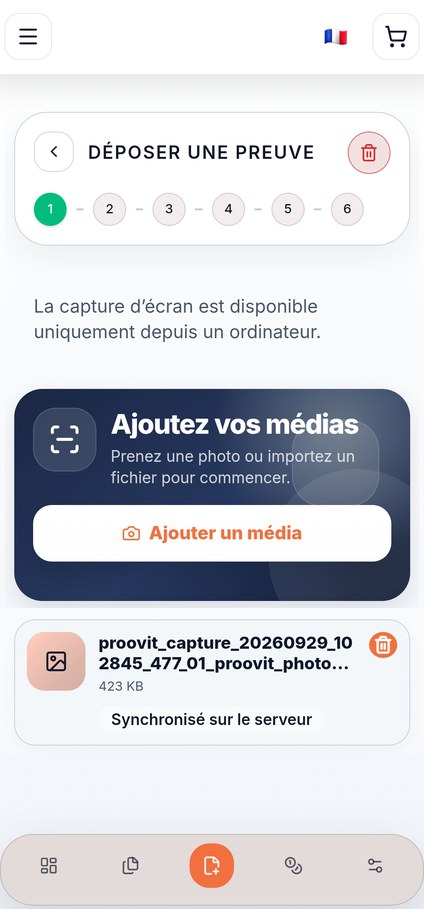
With Proov-It, you photograph the letterbox, the building entrance, the status shown on screen or the opening of an empty box in the mobile app. Each file is timestamped, geolocated if you allow it, and its fingerprint is anchored on a blockchain. A submission costs €2 at most for an individual, and the first one is free.
Legal framework
Who has to prove delivery?
Bought from a business: unless agreed otherwise, the seller must deliver by transferring physical possession or control of the goods to you, without undue delay and no later than 30 days after the contract is concluded (Article 18 of Directive 2011/83/EU). When the seller ships the goods, the risk of loss passes to you only when you, or someone you have designated other than the carrier, acquire physical possession of them (Article 20). A parcel “marked delivered” that you never had therefore remains the seller's risk. In France, for example, the person claiming to be released from an obligation must prove the fact that extinguished it (Article 1353 of the French Civil Code): it is for the seller to prove delivery.
If the parcel does not arrive on time, call on the seller to deliver within an additional period appropriate to the circumstances; if it still does not deliver, you may terminate the contract (Article 18 of Directive 2011/83/EU). You can terminate immediately if the seller has refused to deliver, or if delivery by the agreed date was essential. The seller must then reimburse all sums paid under the contract, without undue delay. In France, for example, the official Service-Public guidance sets this refund at 14 days at the latest.
If you commissioned the carrier yourself, and the seller did not offer that choice, the risk passes to you when the parcel is handed to that carrier, and you deal with the carrier. For a parcel delivered empty or incomplete, the deadline to protest depends on national law: in France, a reasoned protest must reach the carrier within 3 days of receipt, excluding public holidays, by registered letter or through a commissaire de justice (Article L133-3 of the French Commercial Code), or 10 days if you were not allowed to check the parcel (Article L224-65 of the French Consumer Code). Between private individuals, the platform's procedure applies, with its own deadlines. For help, contact your national consumer body or, for a seller in another EU country, your European Consumer Centre (ECC-Net).
Step by step
From stuck tracking to a complaint: the method.
Act quickly: useful traces (pick-up point, neighbours, tracking status) are lost within a few days.
Check the tracking and the surroundings
Read the latest status and any proof of delivery from the carrier (photo, signature, name of the pick-up point). Ask neighbours, the caretaker or reception, check the letterbox and the area around the door.
Day onePhotograph what you find
Empty letterbox, door, building entrance, tracking screen showing “delivered”: a dated submission on the same day shows what you checked, and when. Parcel arrived empty: film the unboxing and weigh the box.
Day oneAsk the pick-up point or the carrier
Delivery to a pick-up point: ask for the collection date and the name of the person who collected the parcel. With some carriers, only the sender can open an investigation: one more reason to go through the seller.
Within 48 hoursWrite to the seller
Purchase from a business: report in writing that you have not received the parcel, ask for a new delivery or a refund, and attach your proof certificate. The seller bears the risk until you take possession: it must show the handover.
Without delaySet a deadline, then terminate
No answer: call on the seller in writing to deliver within an additional period appropriate to the circumstances, and keep a copy. If it still does not deliver, you can terminate the contract and claim a refund of all sums paid.
Additional periodProtest to the carrier you chose
Parcel arrived empty or incomplete, carrier chosen by you: reasoned protest within the deadline set by the applicable law or its conditions (in France, by registered letter within 3 days of receipt, excluding public holidays).
Short deadlineThe Proov-It app
Photograph what you find, on the same day.
Empty letterbox, “delivered” status on screen, box arrived empty: photos and video taken in the app are timestamped and anchored on submission. The first submission is free, no credit card needed. On a computer, you can also submit a screenshot of the tracking online.
What Proov-It adds
What your photos establish, and what they do not.
What the certificate establishes
- +The anchoring date of your photos: letterbox, entrance, tracking on screen, box received empty.
- +File integrity, which the seller or the carrier can check without a Proov-It account.
- +The geolocation recorded at capture in the mobile app, if you allow it.
- +For a parcel that arrived empty, a continuous video of the unboxing, from the closed box to the empty box.
What it does not establish
- −That you did not receive the parcel: an absence cannot be photographed, it is inferred from a set of elements.
- −Who took the parcel, or where it is.
- −Your complaint or your formal notice: you still have to send them, on time.
- −The outcome of the dispute: the seller, the carrier or the platform applies its rules, and the court assesses the evidence in a lawsuit.
Templates
What to write, depending on the situation.
Three short messages to adapt, to send in writing and keep a copy of:
Marked delivered, never received
“Order no. …: the tracking shows delivery on … at …, but I have not received any parcel. Please send me the proof of delivery or deliver again. Dated photos attached.”
Parcel arrived empty
“Order no. …: parcel received on …, sealed but empty when opened, filmed without cuts. Please send the item or refund me. Video and photos attached.”
Deadline to deliver
“Please deliver my order no. … by … at the latest. Failing that, I will terminate the contract and ask you to reimburse all sums paid.”
Use cases
Lost or missing parcel: what you document.
Tracking stuck
Dated screenshots of the tracking, showing since when the parcel has not moved.
Marked delivered, never received
The letterbox, the entrance and the status shown, photographed on the same day.
Pick-up point
The “available” or “collected” status, and the shopkeeper's answer.
Parcel arrived empty
A video of the unboxing without cuts, the weight of the box and the label.
Incomplete delivery
The parcels received, the “1/2” or “2/2” marks on the labels, and what is missing.
Purchase between individuals
The same evidence, attached to the dispute opened on the platform within its deadline.
How it works
A proof in three steps.
No jargon, no technical skills. You submit or you capture, we certify.
Choose or capture
Documents, photos, videos. Or take a photo or video directly in the app.
Add the context
A comment, tags, a folder. To organise your proofs and find them easily.
Submit
You receive a PDF certificate attesting to the file's existence and integrity on the anchoring date and, for a capture made in the app, the geolocation recorded at that moment.
Does it hold up in court?
A Proov-It certificate can be produced as evidence; the court assesses its weight. We attest to the anchoring date, the integrity of the file and, for a capture made in the app, the recorded geolocation, not the truth of its content.
Frequently asked questions
What we are often asked.
What should I do if a parcel is marked delivered but not received?
Check the surroundings, the letterbox, the neighbours and the pick-up point, photograph what you find, then write to the seller. Purchase from a business that organised the delivery: until you have taken physical possession of the parcel, the risk stays with the seller, which must be able to show the handover.
Who is liable for a lost parcel?
The business seller, when it shipped the goods: under EU law, the risk passes to you only when you take physical possession of them (Article 20 of Directive 2011/83/EU). If you commissioned the carrier yourself and the seller did not offer that choice, the risk passes to you when the parcel is handed to the carrier, and you deal with the carrier.
How long should I wait before complaining?
Without an agreed date, the seller must deliver without undue delay and no later than 30 days after the contract is concluded (Article 18 of Directive 2011/83/EU). But do not wait to report a parcel marked delivered that you do not have: the sooner you complain, the easier the traces (pick-up point, neighbours, witnesses) are to find.
My parcel arrived empty: what should I do?
Film the unboxing without cuts if you have not already done so, photograph the box, the label and the seal, then complain to the seller. If you chose the carrier yourself, also send it a reasoned protest within the applicable deadline: in France, for example, by registered letter within 3 days of receipt, excluding public holidays (Article L133-3 of the French Commercial Code).
Can a photo prove that a parcel was not delivered?
Not on its own: an absence cannot be photographed. Your dated photos from the day, the tracking, the pick-up point's answer and your messages together form a file; the seller, the platform or the court assesses their weight. Against a business that shipped the goods, the risk stays with the seller until you take possession, so it is the seller that needs to show the handover.
How much does a Proov-It proof cost?
For an individual, one token per submission, at €2 at most, with no subscription, and the first submission is free. A submission can hold up to 20 files of 100 MB.
Sources and legal texts cited
- French Commercial Code, Article L133-3: protest to the carrier (Légifrance)
- French Consumer Code, Article L224-65: period extended to 10 days (Légifrance)
- French Civil Code, Article 1353: burden of proof (Légifrance)
- Directive 2011/83/EU on consumer rights, consolidated version (EUR-Lex)
- European Commission: European Consumer Centres Network (ECC-Net)
- Service-Public (French government): distance selling, delivery of goods, sheet F10037 (in French)
Keep reading
Related pages
Damaged parcel
Parcel damaged on delivery: what to write on the delivery slip, refusing it, complaining to the seller or carrier, and a dated unboxing video.
Vinted dispute
Item not as described, damaged parcel, dishonest buyer: how to open or answer a Vinted dispute, and which evidence to gather.
Proof of delivery
Couriers, tradespeople, sellers: prove a handover with dated, geolocated photos, and have the recipient sign it.
Timestamped photo evidence
eIDAS Article 41, national rules of evidence, the court's assessment: what gives a photo weight as evidence, and how a timestamp makes it stronger.
Also see: Features · How it works · Pricing · FAQ